The "Great Flattening": AI Is Quietly Eliminating Middle Management — Here's What It Actually Costs
Key Takeaways
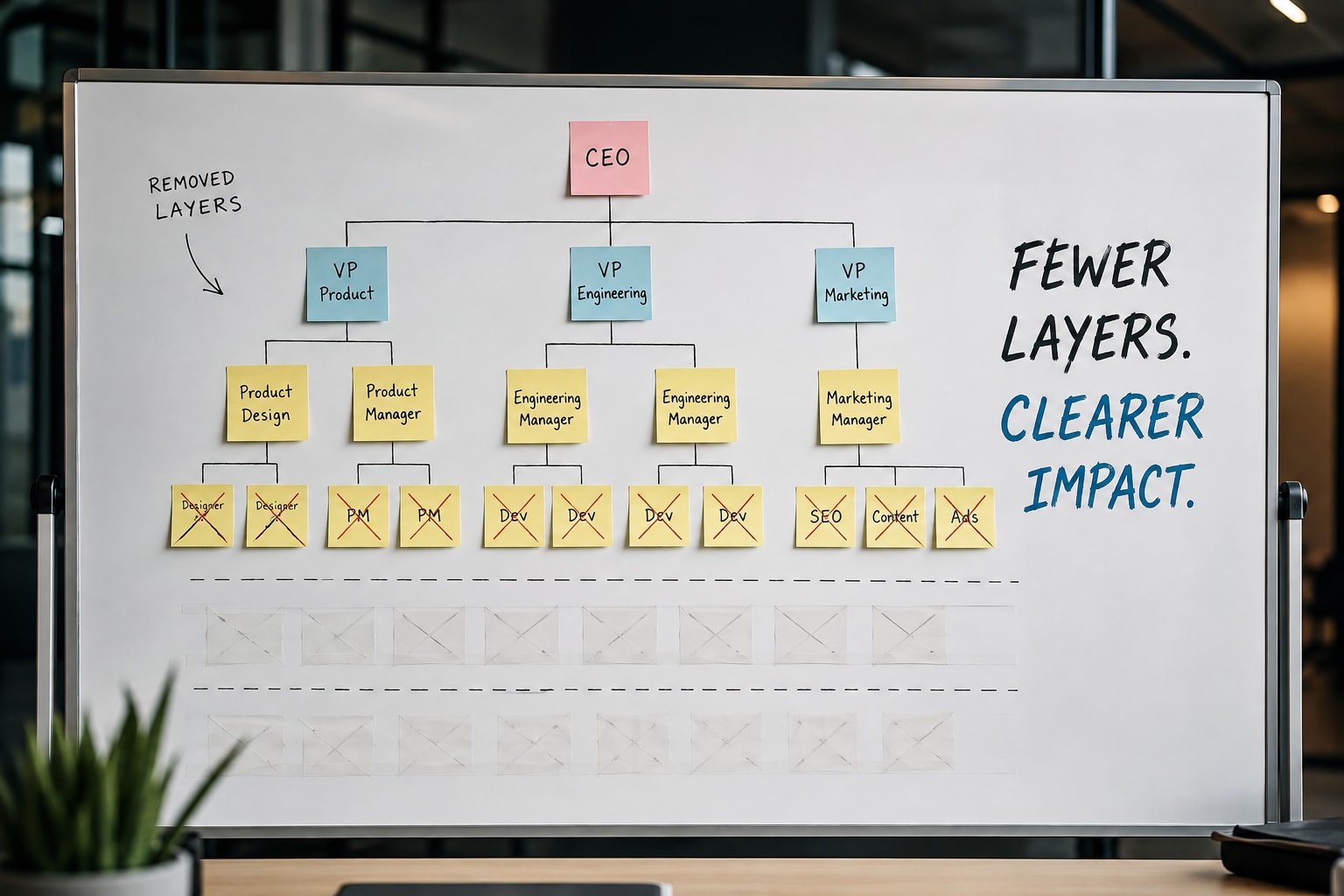
- 41% of employees say their company reduced management layers in the past year, according to Korn Ferry's survey of 15,000 professionals worldwide — a shift researchers and executives are calling "the Great Flattening."
- Manager headcount at public companies fell 6.1% between May 2022 and May 2025, while executive-level headcount fell 4.6% over the same period, according to Live Data Technologies research reported by the Wall Street Journal.
- Gartner projected in October 2024 that 20% of organizations would use AI to flatten their structures by 2026, eliminating more than half of existing middle-management roles at those companies.
- The average manager's span of control — how many people report to them — rose from 10.9 direct reports in 2024 to 12.1 in 2025, according to Gallup, a steep climb from the 8.2 direct reports Gallup recorded when it first measured this in 2013.
- The cuts carry a measurable human cost: 37% of employees who lost a manager in this shift report feeling directionless, and separate research found 72% of executives report feeling stressed by absorbing the coaching and coordination work AI hasn't actually replaced.
What's actually driving the flattening
Middle management, at its core, has historically existed to move information: status updates, task coordination, translating high-level strategy into specific team assignments, and reporting progress back up the chain. As Fortune's coverage of the trend put it, "the traditional corporate pyramid — where information flows up and down through multiple tiers of management — is starting to compress as AI systems take over much of the coordination work that once justified those layers." AI agents that can automatically synthesize status updates, route tasks, and generate reports remove a substantial share of the coordination work that historically required a human manager sitting between senior leadership and individual contributors.
The scale of the shift is well-documented across multiple independent sources, not just a single survey. Korn Ferry's 2025 Workforce Survey of 15,000 professionals found 41% of employees report their organization has already cut management layers. Live Data Technologies' analysis, reported by the Wall Street Journal, found manager headcount at public companies down 6.1% between May 2022 and May 2025, with executive-level headcount down 4.6% over the same window — evidence the flattening extends into senior leadership ranks, not just first-line management. Gartner's October 2024 forecast projected that by 2026, 20% of organizations using AI to restructure would eliminate more than half of their existing middle-management positions. And Gallup's tracking of "span of control" — the number of people reporting directly to a single manager — found that figure climbing from 8.2 in 2013 to 10.9 in 2024 and 12.1 in 2025, a trajectory that has accelerated notably in just the past year.
The names behind the trend
This isn't an abstract statistical pattern — it's visible in specific, named corporate decisions. Meta, Amazon, Google, Intel, and Estée Lauder have all been cited as actively flattening their hierarchies. Block and Coinbase have both publicized restructurings explicitly built around replacing coordination-focused roles with AI systems. Coinbase's chief executive has framed the company's future explicitly around what's been described as an "intelligence layer" — AI systems coordinating work — surrounded by human specialists, rather than a traditional multi-layered management structure. Forbes reporting separately noted that Meta terminated 8,000 employees and Cisco cut 4,000, moves that coverage has directly connected to this broader flattening pattern, alongside the ordinary cyclical restructuring that has occurred across corporate America for decades.
McKinsey has given this emerging organizational model a name of its own: the "agentic organization" — a structure explicitly designed around AI agents handling coordination work, requiring what McKinsey describes as fundamentally new organizational design thinking rather than simply removing layers from an existing pyramid.
The gap between the spreadsheet case and what's happening on the ground
The economic logic behind flattening is straightforward and, on paper, compelling: lower management overhead, faster decision-making, and — according to Gartner's modeling — potentially a 25% reduction in operational costs for organizations that successfully redistribute management responsibilities to AI. For startups and scaling businesses, some analysts have drawn an even sharper conclusion: newer companies may not need to build multiple management layers in the first place, potentially avoiding the "corporate bloat" that established firms are now working to shed.
But the research is equally clear that flattening "looks clean on a spreadsheet and feels chaotic on the ground," as SUCCESS magazine's coverage of the Korn Ferry data put it. In the same Korn Ferry research, 37% of employees who lost a manager during this shift reported feeling directionless. A separate analysis found 72% of executives reported feeling stressed specifically by having to absorb the coaching, context-setting, and feedback work that AI hasn't actually replaced — even as the coordination and reporting tasks that originally justified the management layer have been automated. That distinction is the crux of the problem multiple analyses converge on: AI has proven effective at automating the information-movement function of middle management — status updates, task routing, report compilation — but not the human function: mentorship, coaching, escalation judgment, and the translation of ambiguous strategic direction into concrete guidance a junior employee can actually act on.
The leadership-pipeline problem nobody's pricing in yet
The most serious longer-term concern raised across multiple analyses of this trend isn't about current disruption — it's about where senior leaders will come from in a few years. Executive coach Shaun Warman, whose analysis was covered by Forbes, drew a direct parallel to a similar dynamic already playing out in software engineering: "Just as replacing junior programmers with AI means a shortage of senior programmers in the near future," he warned, "eliminating their middle managers in 2026 are simultaneously dismantling the apparatus that produces senior leaders in 2028." His framing of the resulting risk is specific: "the bench gets thin in two directions at once: the people who would have grown into the role are gone, and the people who might have stepped into it have decided the role is not worth wanting."
That's a distinct and arguably more serious risk than the immediate disruption of flattening itself. Middle-management roles have historically functioned as the primary training ground where individual contributors develop the judgment, coaching ability, and cross-functional coordination skills required for senior leadership. If organizations are removing that training ground at the same time they're expecting AI to handle coordination work, they may be creating exactly the kind of leadership shortage described above — one that won't become visible in quarterly earnings, but will surface a few years out when there simply aren't enough experienced internal candidates ready to step into senior roles, forcing heavier reliance on external senior hires in a market where, as some analysts have noted, that talent pool doesn't yet exist in sufficient numbers.
What organizations that flatten successfully appear to be doing differently
Analysis of the flattening trend consistently identifies one dividing line between organizations navigating it well and those struggling: whether flattening is treated as a deliberate redesign or simply as a cost-cutting exercise applied to an unchanged organizational structure. Organizations that flatten without redesigning how work actually flows tend to see the removed layer's work redistributed unevenly and often badly — senior leaders drowning in operational detail they weren't previously handling, junior employees losing the mentorship and context-translation they need to develop, with AI filling the task layer but not the human layer of connection, coaching, and judgment.
The more effective pattern identified across multiple analyses treats freed-up capacity as an opportunity for capability expansion, not just cost reduction — deliberately redirecting the hours AI gives back toward high-value work teams previously lacked bandwidth for, rather than purely banking the savings. That requires actively redesigning span of control, reporting structures, and — critically — how coaching and mentorship get delivered once the layer historically responsible for it has been removed, rather than assuming AI coordination tools alone are sufficient to replace what a human manager provided.
What this means if your organization is considering flattening its structure
- Separate the coordination function from the human function before deciding what to cut. The research consistently shows AI has genuinely replaced status-reporting and task-routing work, but not coaching, escalation judgment, or context-translation — a flattening decision that doesn't explicitly plan for who delivers those human functions afterward is likely to reproduce the directionless-employee and overwhelmed-executive patterns documented across multiple studies.
- Model span-of-control limits deliberately, rather than letting them drift upward. With average span of control already climbing from 8.2 to 12.1 direct reports over roughly a decade, and accelerating recently, an organization removing a management layer should set an explicit, evaluated target for the resulting span of control rather than treating it as an incidental outcome of the cut.
- Treat leadership-pipeline continuity as a distinct planning problem from near-term headcount savings. Given the specific concern that flattening now may create a senior-leadership shortage a few years out, organizations should explicitly evaluate how they'll continue developing future senior leaders if the traditional middle-management training ground is reduced — a separate question from whether the immediate cost savings are worthwhile.
- Redirect freed capacity toward capability expansion, not only cost reduction. Cost savings are the most visible and immediate benefit of flattening, but the research suggests organizations that also redeploy the freed-up time toward previously under-resourced high-value work capture more of the trend's actual upside, rather than treating it purely as a margin improvement.
Frequently Asked Questions
Is AI actually eliminating management jobs, or just changing what managers do? The evidence points toward a mix of both. Manager headcount has genuinely declined — down 6.1% at public companies between 2022 and 2025 — while remaining managers are handling significantly more direct reports and, per the executive-stress data, absorbing coaching and coordination work AI hasn't automated. It's a combination of real headcount reduction and a changing role for those who remain, rather than a single clean story.
Which industries are most affected by this trend? Technology companies have been the most visible and frequently cited examples — Meta, Amazon, Google, Block, and Coinbase all appear repeatedly in coverage of this trend — though the underlying Korn Ferry and Gallup data reflects a broad, cross-industry survey sample rather than a technology-sector-specific phenomenon.
Does flattening always lead to cost savings? Not automatically or without risk. While Gartner's modeling points to potential operational cost reductions of around 25% for organizations that successfully redistribute management responsibilities to AI, the same research base documents real costs — employee disorientation, executive stress, and potential long-term leadership-pipeline damage — that can offset or complicate those savings if flattening isn't paired with deliberate organizational redesign.
What should an employee do if their manager was eliminated in this shift? While this article doesn't offer individualized career advice, the research is clear that a documented, common experience among affected employees is a loss of the context, coaching, and direction a manager previously provided — proactively seeking out alternative channels for that guidance (senior leaders, peer mentorship, or formal development programs) is a pattern the research suggests is worth pursuing rather than assuming AI coordination tools alone will fill that specific gap.
Sources & References
- Fortune, "AI agents are flattening corporate hierarchies. Here's how companies—and managers—can develop a new playbook" (June 9, 2026)
- SUCCESS, "AI Is Flattening Management: Here's How to Lead Now"
- Forbes, "How AI Is Compressing Management Layers Across Corporate America" (May 21, 2026)
- Forbes, "Management Cuts Today Are Shaping A Leadership Shortage" (June 30, 2026)
- Lepaya, "The Great Flattening: Middle Management Cuts in the AI Era"
- AI CERTs, "Autonomous AI Agents Redefine Corporate Management Layers"
- Korn Ferry, 2025 Workforce Survey
Related Reading
For a related look at how AI is reshaping headcount and organizational structure in a specific white-collar industry, see PrimeWorldMedia's coverage of AI's disruption of the management consulting industry — both stories describe the same underlying dynamic (AI absorbing coordination and analytical work) playing out at different organizational levels.