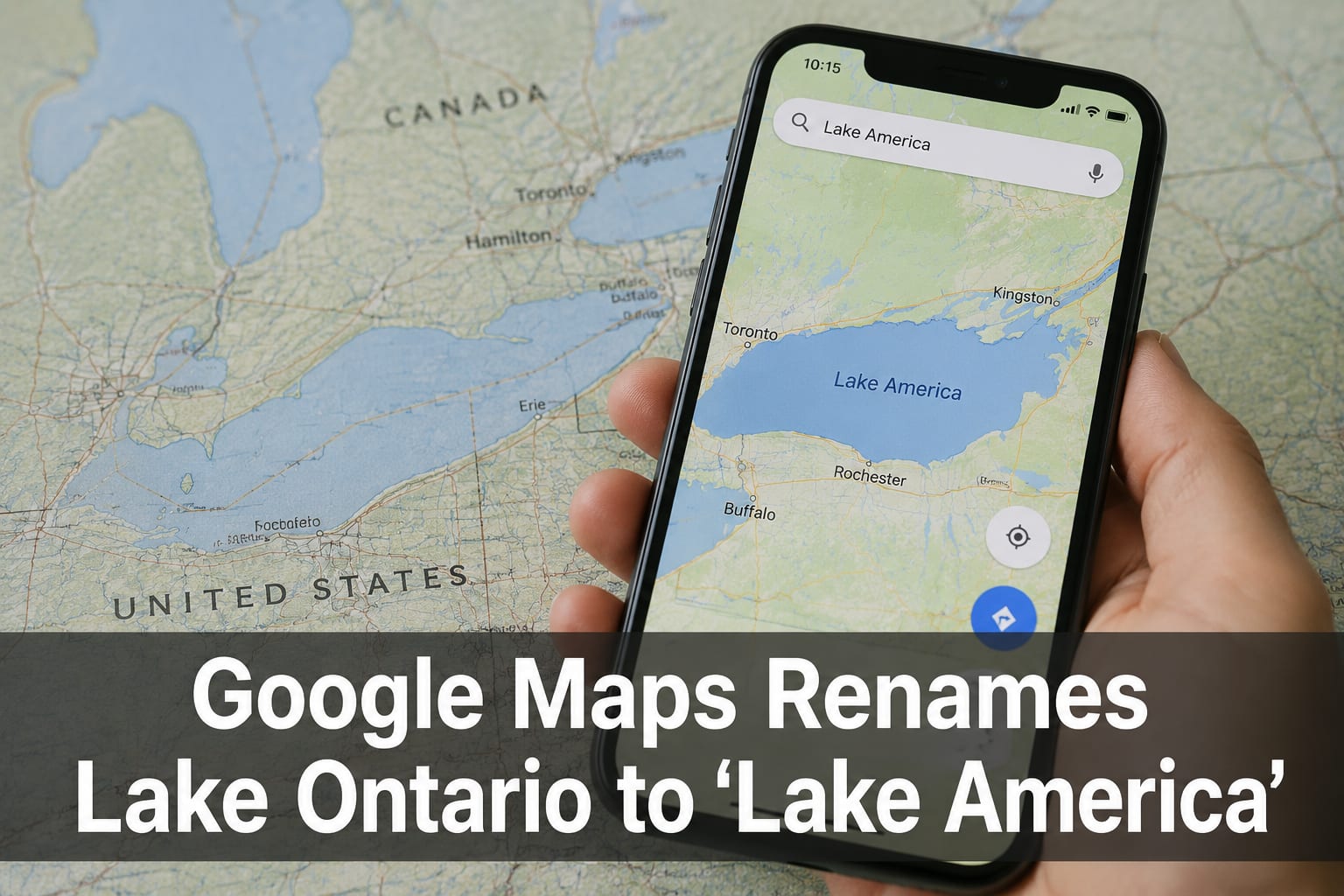
Google Maps Now Shows "Lake America" Instead of Lake Ontario — But Only If You're Standing on the US Side
This article summarizes company statements and government actions on a developing naming dispute. Details may be updated as further official responses emerge.
Key Takeaways
- Google Maps began displaying "Lake America" in place of "Lake Ontario" for users in the United States starting Saturday, August 29, 2026, following a formal update to the U.S. Geographic Names Information System (GNIS).
- The change traces back to an executive order President Trump signed Thursday, August 27, directing the Interior Department to rename Lake Ontario as "Lake America" for federal purposes.
- Users in Canada continue to see "Lake Ontario" on Google Maps, while users outside both countries see both names displayed together, with "Lake America" shown in parentheses.
- The order arrived amid an escalating US-Canada trade dispute, after Trump imposed 50% tariffs on roughly $20 billion worth of Canadian goods and Canadian Prime Minister Mark Carney vowed "dollar for dollar" retaliation.
- Ontario Premier Doug Ford dismissed the renaming as pointless, saying "no one's going to call it Lake America," while Apple Maps had not made the corresponding change as of the most recent reporting.
How a lake got caught in a trade war
The renaming order didn't emerge in isolation — it followed a public back-and-forth between Trump and Ontario Premier Doug Ford after trade talks between the U.S. and Canada collapsed in the preceding weekend. Trump had already imposed tariffs of up to 50% on about $20 billion worth of Canadian goods, and Carney responded by promising retaliation matched dollar for dollar. Ford, for his part, had been openly critical of Trump throughout the dispute, at one point debuting a large sign on the Ontario shoreline reading "Lake Ontario, Now and Always" as a pointed rebuttal to the renaming effort, and separately calling Trump "a bully" and "a loser."
Trump signed the executive order — invoking Executive Order 14172, "Restoring Names That Honor American Greatness" — on Thursday, August 27, directing Interior Secretary Doug Burgum to work with the U.S. Board on Geographic Names to update GNIS, the federal system used to standardize geographic names for federal use. In his order, Trump wrote that "the Lake will continue to play a pivotal role in shaping America's future and the global economy," describing the renaming as recognition of "this flourishing economic resource and its critical importance to our Nation's economy and its people."
Why Google changed its maps so quickly
What drew particular attention — and some criticism — was the speed of Google's response. The executive order itself gave the Interior Department up to 30 days to complete the renaming process, but GNIS was formally updated within roughly 48 hours, and Google Maps followed almost immediately after. In a statement, Google explained the mechanism behind the update directly: "Since we update Google Maps to reflect name changes in official government sources, which is GNIS for the U.S., people using Maps in the U.S. will see 'Lake America,' those in Canada will continue to see 'Lake Ontario,' and those outside of the United States and Canada will see both names." The company characterized this as consistent with its "long-standing policy for bodies of water with names that vary from country to country," rather than a one-off decision specific to this dispute.
That speed drew a mixed reaction, according to reporting on the change — some Canadians, Americans attached to the lake's traditional name, and people who'd learned the Great Lakes via the "HOMES" mnemonic (Huron, Ontario, Michigan, Erie, Superior) online expressed frustration at what they characterized as the company complying unusually quickly with a politically charged directive, compared to the 30-day window the order itself allowed.
This isn't Google's first geopolitical naming decision
The Lake Ontario situation directly mirrors an earlier precedent: Google Maps similarly updated to show "Gulf of America" instead of "Gulf of Mexico" after Trump signed a comparable executive order earlier in his term, a change that prompted its own share of controversy at the time, including formal objections from Mexican President Claudia Sheinbaum, who noted the U.S. order only had authority over the portion of the body of water within U.S. jurisdiction. Trump's January 2025 order had separately directed a reversal of the Obama-era renaming of Denali back to "Mount McKinley" in official U.S. government references, another instance of the same underlying pattern: a president directing a change to GNIS, and Google subsequently updating its consumer-facing maps to reflect the new official U.S. government name specifically for U.S.-based users.
What this means practically for anyone using the map
For everyday users, the visible effect is narrow but real: open Google Maps in the United States and search for the lake between New York and Ontario, and the label now reads "Lake America." Cross into Canada, or set your device region to Canada, and the same body of water is still labeled "Lake Ontario." Users accessing Maps from outside both countries see a combined label — "Lake Ontario (Lake America)" — reflecting Google's stated policy of displaying both a location's local official name and any other officially recognized name where they diverge by country. As of the most recent reporting, Apple had not made a comparable update to Apple Maps, meaning the two most widely used U.S. mapping apps currently disagree on what to call the lake — a detail that, on its own, illustrates how contested and unsettled this particular renaming remains outside of Google's specific platform.
Frequently Asked Questions
Is Lake Ontario's name officially changed everywhere, or just on Google Maps? The change applies specifically to U.S. federal government references and platforms that follow the U.S. Geographic Names Information System, such as Google Maps for U.S. users. Canada has not adopted the change, and the lake's international status outside U.S. jurisdiction is unaffected.
Why do Canadian users still see "Lake Ontario"? Google's stated policy displays a location's officially recognized name according to each country's own government sources; since Canada has not renamed the lake, Canadian users continue to see the name Canada officially recognizes.
Has this happened with other geographic names before? Yes — Google Maps made a similar change for U.S. users when Trump ordered the Gulf of Mexico renamed "Gulf of America" earlier in his term, and separately reversed Denali's name back to Mount McKinley in official U.S. federal references.
Is this related to the US-Canada trade dispute? The renaming order followed shortly after trade talks between the two countries collapsed and the U.S. imposed new tariffs on Canadian goods, with Canada announcing retaliatory measures — the timing has led most reporting to frame the lake renaming as connected to that broader trade conflict.
Sources & References
- Fox Business, "Google Maps switches to 'Lake America' after Trump orders Lake Ontario rename"
- CBS News, "Google updates maps to show 'Lake America' in U.S. after Trump executive order directing name change"
- TechRepublic, "Google Maps Renames Lake Ontario 'Lake America' After Trump Order"
- Rolling Stone, "Google Maps Changes Lake Ontario to Lake America After Trump's Executive Order"
- MSNOW, "Google Maps renames Lake Ontario to Lake America"